SLT’s ‘La Cage aux Folles’ is anything but a drag
By ALAN SMASON, WYES-TV Theatre Critic (“Steppin’ Out“)
Scott Sauber has proven to be an accomplished and impressive performer in recent years. Already a successful director and lighting director behind the scenes, he has also proven to be a true triple threat as an actor, singer and dancer on the stage. His comic portrayal of Ogie in JPA’s Waitress last year earned him critical kudos and a Crescent City Theatre Award for Best Supporting Actor in a Musical.
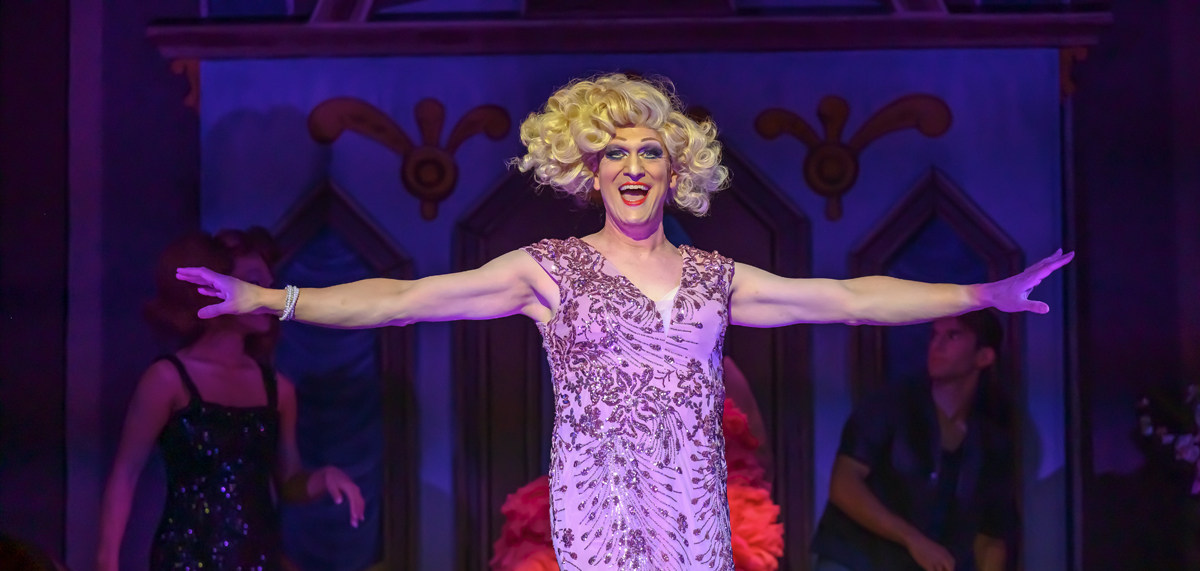
Now, he has stepped up his game even more by assuming the dual roles of Albin and his alter ego of drag superstar Zaza in the Summer Lyric Theatre at Tulane’s second summer production of Jerry Herman (music and lyrics)and Harvey Fierstein’s (book) La Cage aux Folles.
Sauber’s emotional Act One closer of “I Am What I Am” is a case in point. The number starts slowly a capella and builds with increasing accompaniment from the orchestra led by artistic director C. Leonard Raybon. As the song moves towards and finally reaches its crescendo, Zaza becomes ever more defiant, eventually removing his wig and running off the stage and up the aisle at Dixon Hall in what can only be described as a tour-de-force performance.
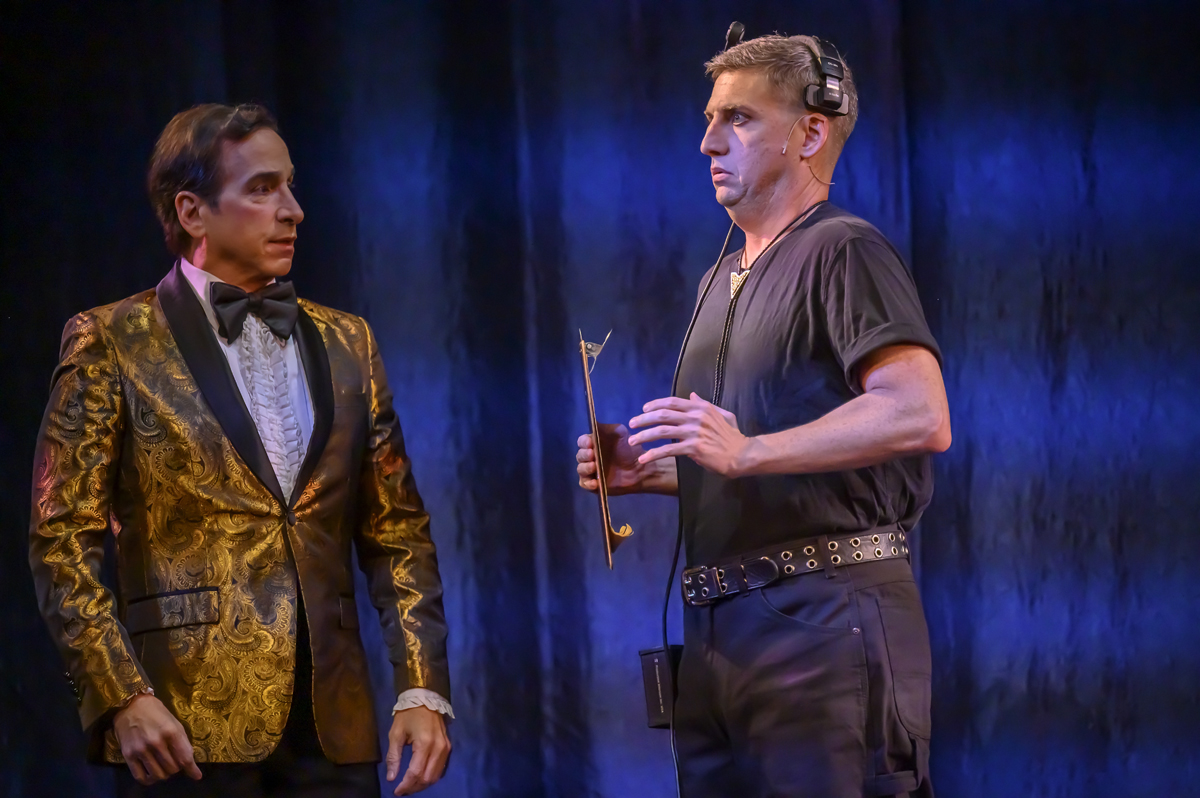
Sauber’s comical skills also notably come into play during the presentation of the number “Masculine” in which his longtime partner Georges (Michael Paternosto) attempts to oversee a manly makeover of Albin, now sporting a black ensemble and wearing pants.
The simple act of buttering a slice of toast becomes a lesson that requires enormous effort by Albin and infinite patience by Georges. Paternostro, who has enjoyed several leading roles in recent years at Summer Lyric Theatre (A Little Night Music) and Le Petit Theatre (Goodnight, Oscar), has a more tricky job with the role of Georges, literally playing a “straight” man to Sauber’s outrageous stage presence.
He waxes romantically in “Song on the Sand” and takes up for his partner and their mutual love they share for their son, Jean-Michel (Luke Boucvalt), in “Look Over There.” Director Diane Lala might well have taken a note from Arthur Laurents, the fabled director of the original Broadway cast of La Cage aux Folles. Laurents advised original star Gene Barry to look deep into George Hearn’s eyes to convey to the audience of the depth of his affection and love for one another. While Paternostro’s singing is on pitch and lands well on the ear, his performance as Georges seems more mechanical and cold than it should.
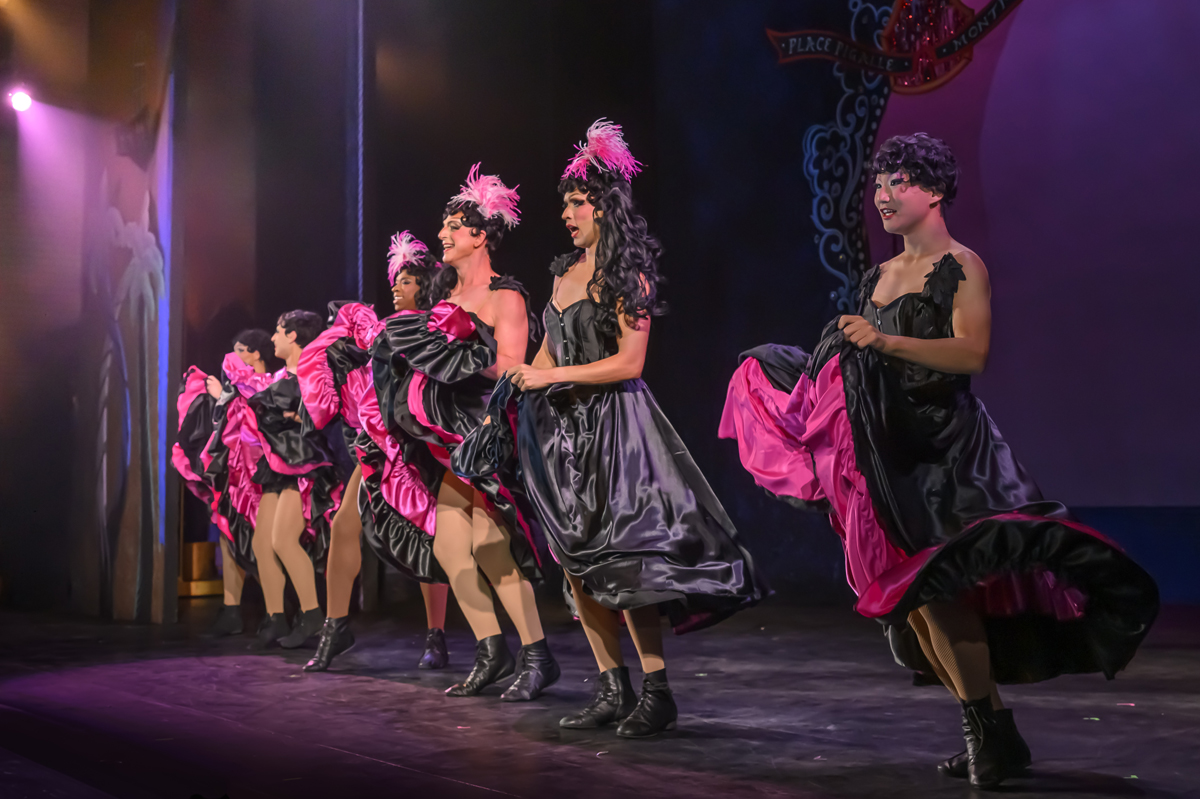
Of course, the title of the work alludes to the controversial nature of the club La Cage aux Folles, located downstairs from their French Riviera apartment. The ensemble of six core members are known collectively as Les Cagelles and consist of Daniel Rigamer, Aaron Brewer, Kata Kawahara, Jusice Hues, Garrin Mesa and Donavan Allen Davis.
The club La Cage aux Folles is a place where men can be women at every performance, and they issue their proud and declaratory anthem in “We Are What We Are.” As in real life, there are squabbles over how much time they spend on stage. These are settled by Georges. But as to the star, there is no question that it is Zaza and we know it intuitively. Zaza is more at home with herself when her female side emerges than when we see Albin.
When Jean-Michel first establishes his presence, we are puzzled as to the nature of just who he is. Clearly, Georges is stricken with him but we learn he is in fact his son, the result of an unlikely tryst with a woman. In “With Anne on My Arm,” we learn he is fully in the throes of love for his Anne Dindon.
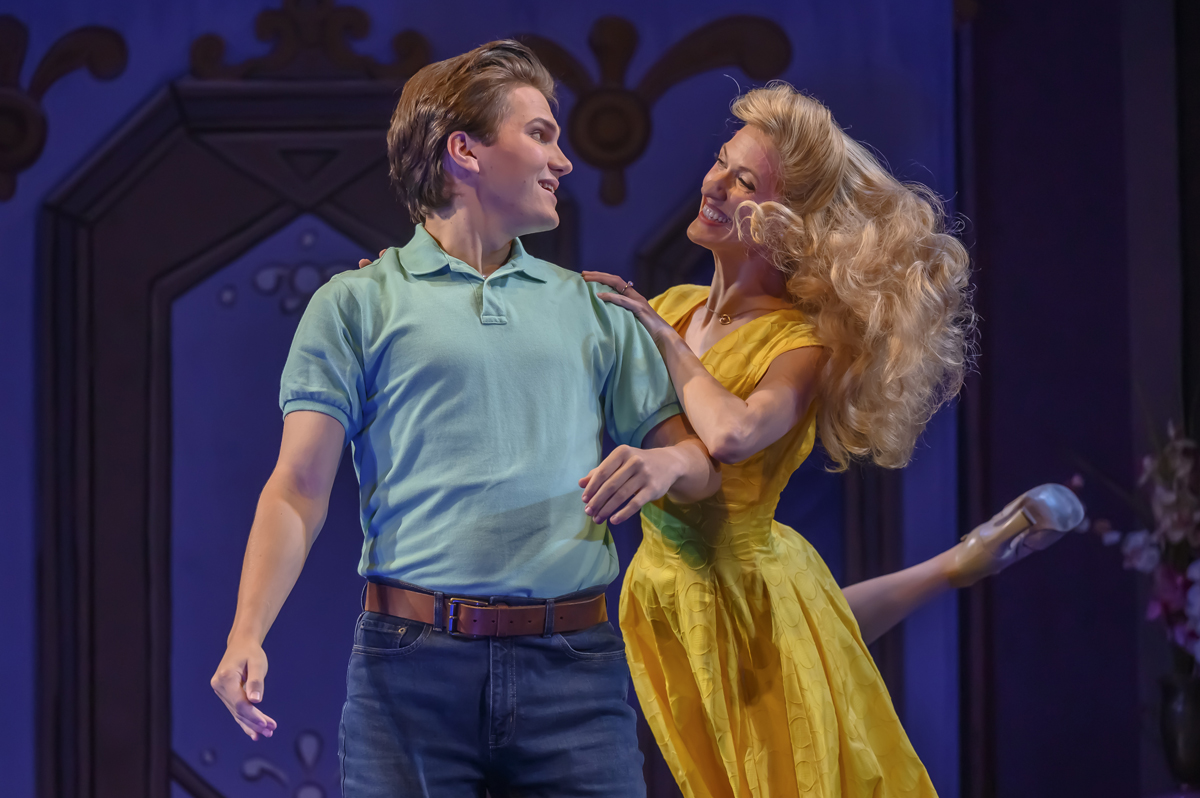
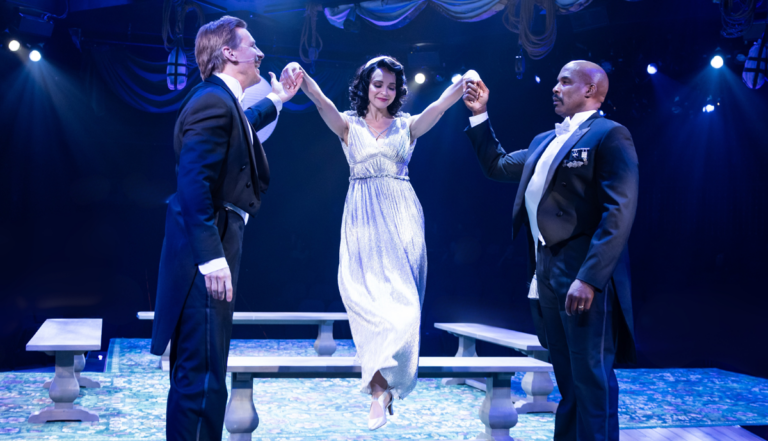
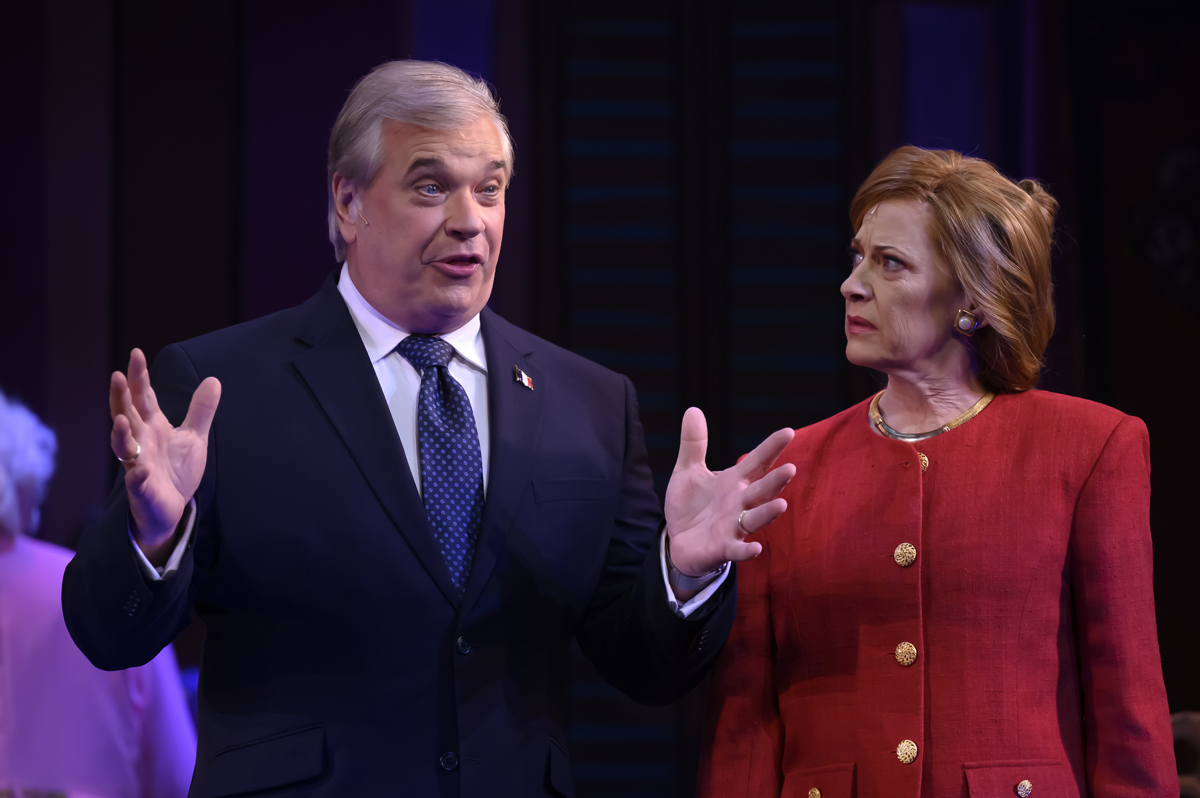
Jean-Michel’s dilemma is that Anne is the daughter of the prudish and conservative politician Edouard Dindon, played with authority and with accompanying homophobia by Lala’s real life husband, Robert Pavlovich. Also, on Edouard’s arm is his wife Marie, played by longtime SLT leading actress Elizabeth Argus. We see precious little of Camille in Act One, where she appears only as an image in Jean-Michel’s mind. We do get to see much more of her in Act Two, when she arrives at Georges and Albin’s apartment with her parents in tow. The parents are to meet one another for the first time in advance of the upcoming nuptials of the young couple.
Fierstein’s book was once a very strong and fresh approach to gay couples prior to the legalization of gay marriage in 2013 in France and in 2015 in the United States. There had never been a musical before with gay couples featured so prominently and matter-of-factly. But today, the use of some terms that are used in the dialog like “transvestite” are now considered as problematic.
The clash of the two sets of parents is heightened ever more by the entrance of restaurateur Jacqueline, an old companion of Georges and Albin, played by Maria Hefte. In “The Best of Times,” she and Zaza launch into what turns out to be the 11th hour number. It is a spirited and affirming song in the march larger work that seems to be reassuring, especially given the fact it was written during the beginning of the AIDS crisis in the U.S.
Lala, who also serves as choreographer, handles the performances at the club and the big production numbers quite creditably. The costumes are especially noteworthy and fabulously designed by Erick Sundquist with superb wig and makeup designs by Laurin Hart. The entire backstage operation does require a village to place every sequin and bead properly, while also making sure that the most appropriate hair pieces are coiffed appropriately.
Kudos to Daniel Zimmer for very effective lighting and to David Rigamer, who designs the sound. Raybon’s conducting is superb and the sound elicited by just nine musicians is remarkable. It would seem that the number of live musicians is much larger than what is located in the pitt at Summer Lyric Theatre at Tulane University.
What tickets remain for La Cage aux Folles are available by dialing 504-865-5269. The show based on the play by Jean Poiret finishes its run at Dixon Hall on the Tulane campus today, Sun., July 12, at 2 p.m.